I get this question a lot. Emails from Phd-students or postdocs thinking about making the switch to scientific illustration, wanting to know how I did it, whether it’s realistic, and what to expect. For years I answered each one individually. This post is my attempt to write a proper answer once and for all.
Before we start: this is written for scientists, people who already have a degree in biology, chemistry, physics, or a related field and are wondering whether they could combine that background with illustration work. If you’re coming from an art or design background, I’m not the right person to ask because that’s not the path I took.
A question I get often is whether there are companies or institutes where you can learn scientific illustration as an employee, because diving right into freelancing may seem scary. The honest answer is that it’s difficult. Organizations that employ in-house scientific illustrators (big research institutes, the occasional journal) are typically looking for people with serious experience, not someone just starting out. There is strong demand for high quality scientific illustration, but much less for work from someone whose skills are still developing. From my view for many people, freelancing may be the only realistic way to get started, build experience, and develop the portfolio that might eventually open other doors. I don’t want to be discouraging but it’s worth knowing before you start looking for job listings that largely don’t exist.
How I got here
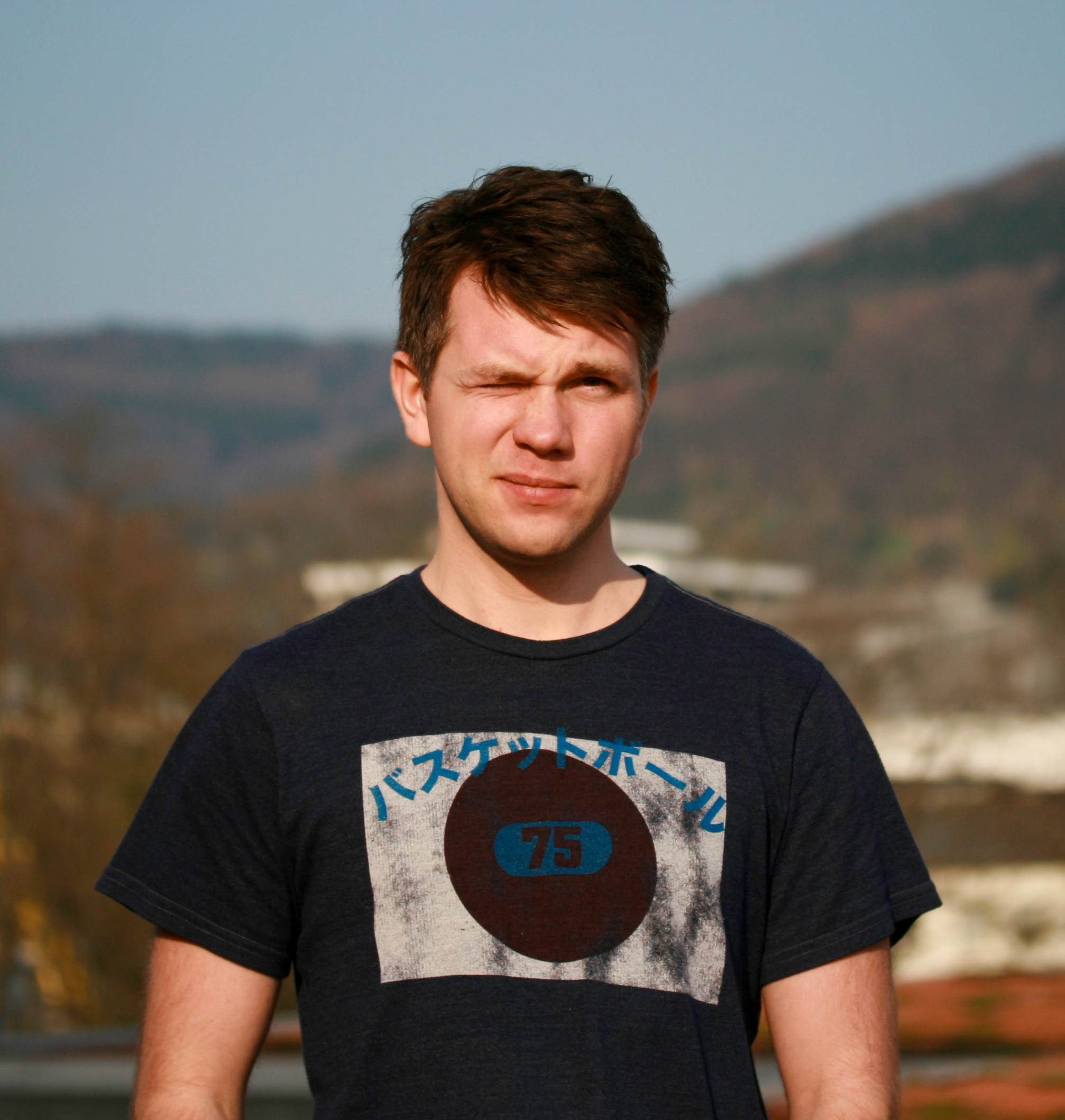
Me during my PhD years
It wasn’t just a career choice. It was actually more of an identity crisis. I had grown up thinking I was born to become a scientist. I first got into molecular biology but it was only somewhere in the middle of my PhD in computational biology at Heidelberg, that I came to realize that doing research wasn’t actually for me. I was pretty lost, I had no idea what to do. This was the only thing I had ever trained for. Starting over from scratch in a completely different field seemed impossible.
What helped was asking the people around me. I went to labmates and friends and asked them directly: where do you see me in ten years? Almost everyone said something creative. That surprised me, because I hadn’t seen it in myself. But it got me thinking. I always had a thing for creative, visual things but to me these were always just hobbies. And there were clues. I hated painfully writing manuscripts but I loved working on the figures for those same papers and spend much time on them.
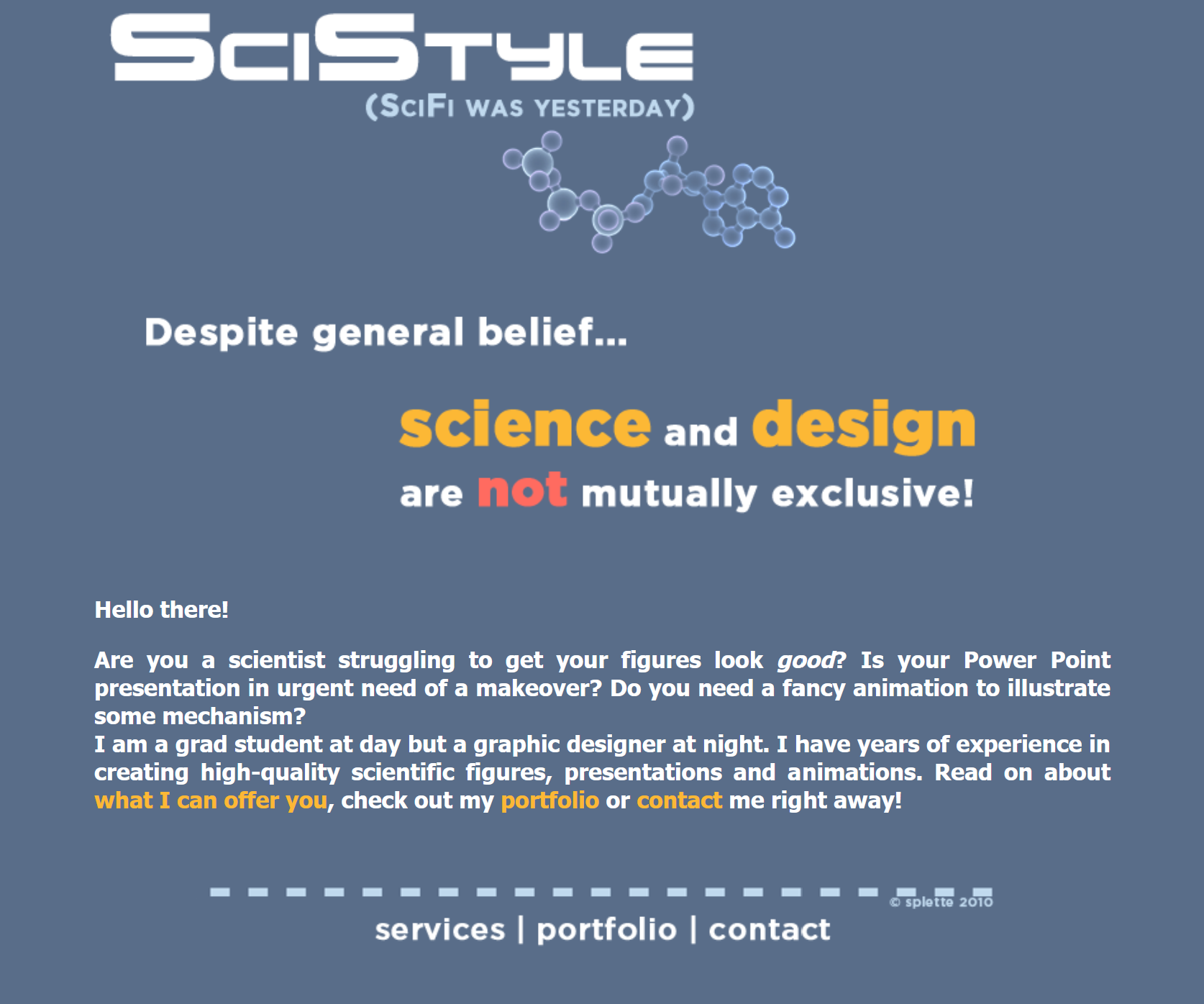
My very first SciStyle website (2010)
Even then, the idea of scientific illustration didn’t come to me on its own. At the time it was such an exotic profession that it simply didn’t cross my mind as a possible career option. Then I stumbled across the website of Graham Johnson, a scientific illustrator whose work and story I found genuinely inspiring. That was the moment I thought: wait, this is actually a thing? I want to do this!
Once that idea was planted in my head, I was completely convinced. Combining my background in biology with my newly found passion for visual work just felt so right. That conviction (stubbornness really) carried me through the hard early days.
I had roughly the last two years of my PhD to prepare. I already knew some Photoshop, learned Adobe Illustrator from scratch, registered and built my first SciStyle website, started helping postdocs in my lab and neighboring labs with their figures, and gradually found my first clients on campus. By graduation I had a small portfolio and a few paying clients. I thought the transition to full-time freelancing would be relatively smooth. Oh boy, was I wrong about that, but more on that later.
Learning the tools
Scientific illustration doesn’t require formal training. I never enrolled in any design program. The kids on YouTube can teach you anything these days. Everything I learned came from online tutorials, and that worked fine, although there are few that are specific for scientific illustration.
The most important tool to learn first is a vector graphics program to create figures, format plots and such. My choice was Adobe Illustrator, which remains the industry standard and the most capable option. If you’re serious about this professionally, I still recommend it, though subscription costs are annoying. Affinity Designer is a genuine alternative: free, easy and intuitive to learn but less powerful than Illustrator.
And for those fancy 3D renderings I chose Maxon Cinema 4D, which is a joy to use. It’s a well-rounded program that can get real results quickly, which makes it a good fit for generalists, which is exactly what a freelancer has to be. The learning curve of any 3D software is much steeper than Illustrator. The downside is the steep subscription cost. If I were starting today I would take a serious look at Blender first: it has improved enormously, it’s completely free, and it has a growing user base in the scientific community, which also opens up possibilities like teaching workshops further down the line. There are other more powerful 3D packages out there, but they are highly specialized and difficult to learn. For a generalist freelancer, Cinema 4D or Blender are the right choices.
My work often involves illustration on the molecular scale, and for that I need to use molecular visualization software. PyMOL is my preferred choice. Chimera is another widely used option. But their internal render engines are very basic. So their main task is to load in the raw structural data and chose the needed representation of the protein/DNA/molecule etc. and then export the 3D model to load it into Cinema 4D or Blender where you can apply proper textures, lighting and rendering. If you already know one of these programs from your science work, stick with it.
My thoughts on generative AI

AI generated virus: fancy-looking garbage.
People ask about this regularly, so here’s my take (as of 2026).
I believe that scientific illustration is one of the harder areas for generative AI to replace, at least for now. The work is extremely specific, scientifically accurate by necessity, the AI training data for solid scientific illustration is thin and the journals do not permit AI-generated figures (at least for now). Beyond that, a significant part of what I actually do is not drawing per se, but understanding complex science and finding a way to translate it into something clear and visually coherent. That process, the back and forth with a researcher, the decisions about what to show and what to leave out, is not something current AI tools handle well.
Where I do see generative AI being quite useful is in the brainstorming phase. I’ve already noticed clients using it to generate rough reference images before our first conversation, which actually saves time and helps communicate what they’re after. As a mood board or style reference tool it works well.
All this may change significantly in five or ten years. Ask me again then.
Building a portfolio (and a website)
Your portfolio is the single most important thing when you’re starting out! Clients want to see what you can do, what your style looks like, and what kind of work you’ve already made. Nothing else you do in the first year matters as much as having something polished to show.
It doesn’t need to be large. A handful of genuinely strong pieces is better than a large collection of mediocre ones. And they don’t need to come from paying clients. Illustrations from your own research, figures you made for labmates, or personal projects done purely to practice are all fine. I made a lot of illustrations for Wikipedia during my PhD, mostly as a way to avoid writing my thesis. Some of them made it into my early portfolio. Unpaid and self-initiated work is completely valid, as long as it looks professional.
Two things matter when choosing what to include.
First: keep it focused. The temptation is to show your full range of creative skills. Don’t do it. If you also model fantasy figures in Cinema 4D, or paint landscapes, or do graphic design work unrelated to science, leave it out. Your portfolio should show one thing clearly: that you can create high-quality scientific illustration. Personal projects are fine, but they should have a scientific context.
Second: you get hired for the work clients see in your portfolio. Sounds obvious but it has real consequences. If you include work you don’t actually want to do more of, you’ll still keep getting requests for it. I used to offer webdesign for clients because I could, and because some asked. But I didn’t enjoy it. Once I stopped showing it, nobody asked anymore. The reverse is also true: if there’s a type of work you want more of, make personal projects in that style and put them in. The illustrations in your portfolio are a signal to potential clients about what you do, so be deliberate about what signal you’re sending.
Quality is key: before anything goes into your portfolio, make sure it’s genuinely polished. If you have a piece that’s mostly good but not quite there, spend the extra time finishing it properly before posting it. Show the best you’re capable of.
For getting online quickly, a dedicated portfolio hosting site is a reasonable starting point. You don’t need a full website immediately. When you’re ready to build one properly, I recommend WordPress with a well-established and regularly updated theme. If you don’t want to deal with the technical side, managed builders like Squarespace are okay but offer less flexibility. Either way, the website should tell visitors immediately what you do, who you do it for, and how to reach you.
The business reality
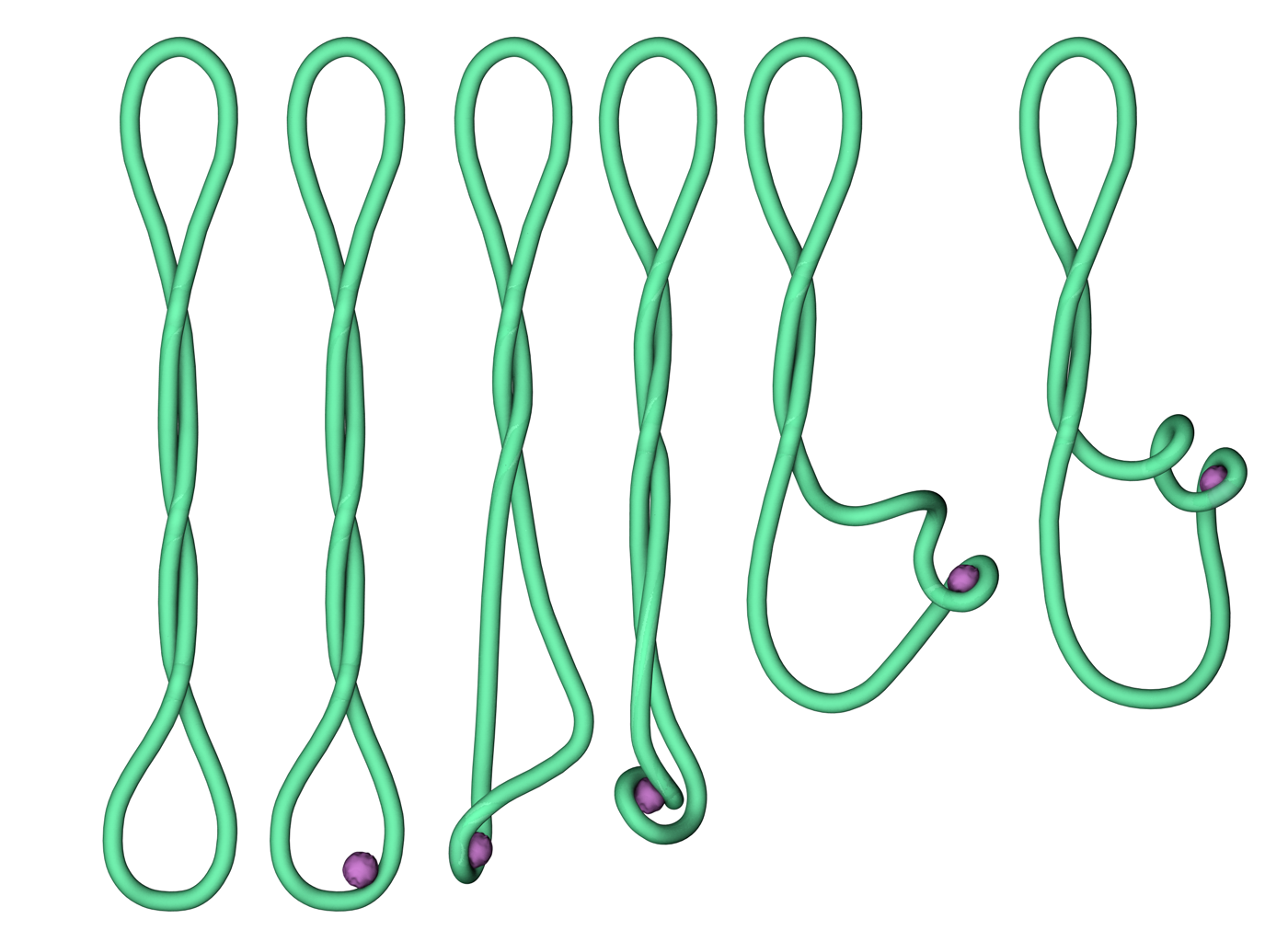
Humble beginnings: My very first *paid* figure made in 3D. (2010, DNA wrapping around a protein)
This is the part nobody told me, and the part I wish someone had.
I graduated in 2010 with a small portfolio, a few clients, and the assumption that the transition to full-time freelancing would be relatively smooth, because I had already been doing some illustration work during my PhD. How hard could it be?
Ha! Much harder than I expected, and I made it harder still by not taking it seriously enough from the start. My first move after graduation was to go backpacking through North, Central and South America for two years, laptop in hand, convinced I could build a freelance career while traveling. The digital nomad lifestyle sounded so appealing …in theory. In practice, when you’re constantly moving, dealing with unreliable internet, heat, noise and constant distraction, doing serious focused work is difficult. I still travel for extended periods and work remotely every year, and I still run into some of these problems. During those first two backpacking years I had some clients, but nowhere near enough. Looking back, that period set me back considerably.
When I finally settled in Berlin in the end of 2012, and I decided to treat this as a real business, things started to improve. But even then it took a few more years to reach something resembling financial stability, much longer than I had initially anticipated. I naively thought I could reach it it in a year or so.
Mistakes were made
I didn’t do a business plan. I didn’t sit down and calculate how many hours I needed to bill per month, at what rate, to cover my costs. That would have forced me to think clearly about pricing from the start, but I skipped it entirely.
I started with rates that were too low and raised them too slowly. Part of this was a confidence problem. I was self-taught, I hadn’t come through a formal design education, and I sometimes struggled to see myself as a professional who could charge accordingly. It took years to fully accept that extensive experience and a long list of happy clients is actually worth something, regardless of how you got there. If you’re starting out: raise your rates sooner than feels comfortable, and do it regularly.
I also didn’t distinguish between good projects and bad ones. A single small illustration sounds fine until you factor in the initial client call, the back and forth, the invoicing, the payment logistics for an overseas institution filling out three forms to wire money to Germany. Sometimes the overhead consumed more time than the illustration itself. Projects where I could work consistently for many hours and send one invoice at the end were far more valuable. Learning to recognize and prioritize those took longer than it should have.
One book that genuinely helped me think more clearly about all of this early on was “Work for Money, Design for Love” by David Airey. It’s aimed at designers but the thinking applies directly. Worth reading before you take on your first clients.
On taxes: I don’t care to understand taxes in Germany and I made peace with that early by getting an accountant. With clients across Europe, the US and elsewhere, billing rules vary considerably depending on where the client is based, and making mistakes with international invoicing is easy. An accountant in Germany is not cheap, but the peace of mind has been worth it for me. Whether you need one depends on your situation, but at minimum make sure you understand the basics of how freelance income is taxed in your country before you start invoicing anyone.

15 years later: A recent 3D cover concept showing course graining.
There is a high demand for high quality scientific illustration. But when you’re starting out and your skills are still developing, the market for entry-level work is smaller. This is just the reality. The good news is that once you reach a high enough standard, there is plenty of work. The challenge is getting through the gap between starting and being good enough.
I made that gap longer than necessary by relying almost entirely on word of mouth, I am simply bad at advertising myself. Word of mouth is eventually the best source of clients, but it is slow, especially in the beginning. I highly recommend putting yourself actively in front of potential clients, especially in the early days: telling everyone from your university years what you are doing, getting on LinkedIn, Bluesky, Instagram, reaching out to labs directly, make yourself visible wherever possible. I didn’t do nearly enough of that, and it cost me time.
It’s also worth thinking early about who you actually want to work for. Scientific illustration covers a wide spectrum. At one end are studios like MadMicrobe that produce stunning animations for large pharmaceutical clients with large budgets, working in teams on high-production projects. At the other end are individual freelancers like me, working directly with the researcher at publicly funded universities. The budgets are very different. So is the nature of the work. I’ve always stayed close to the academic side because this is where I feel most comfortable and my work really matters.
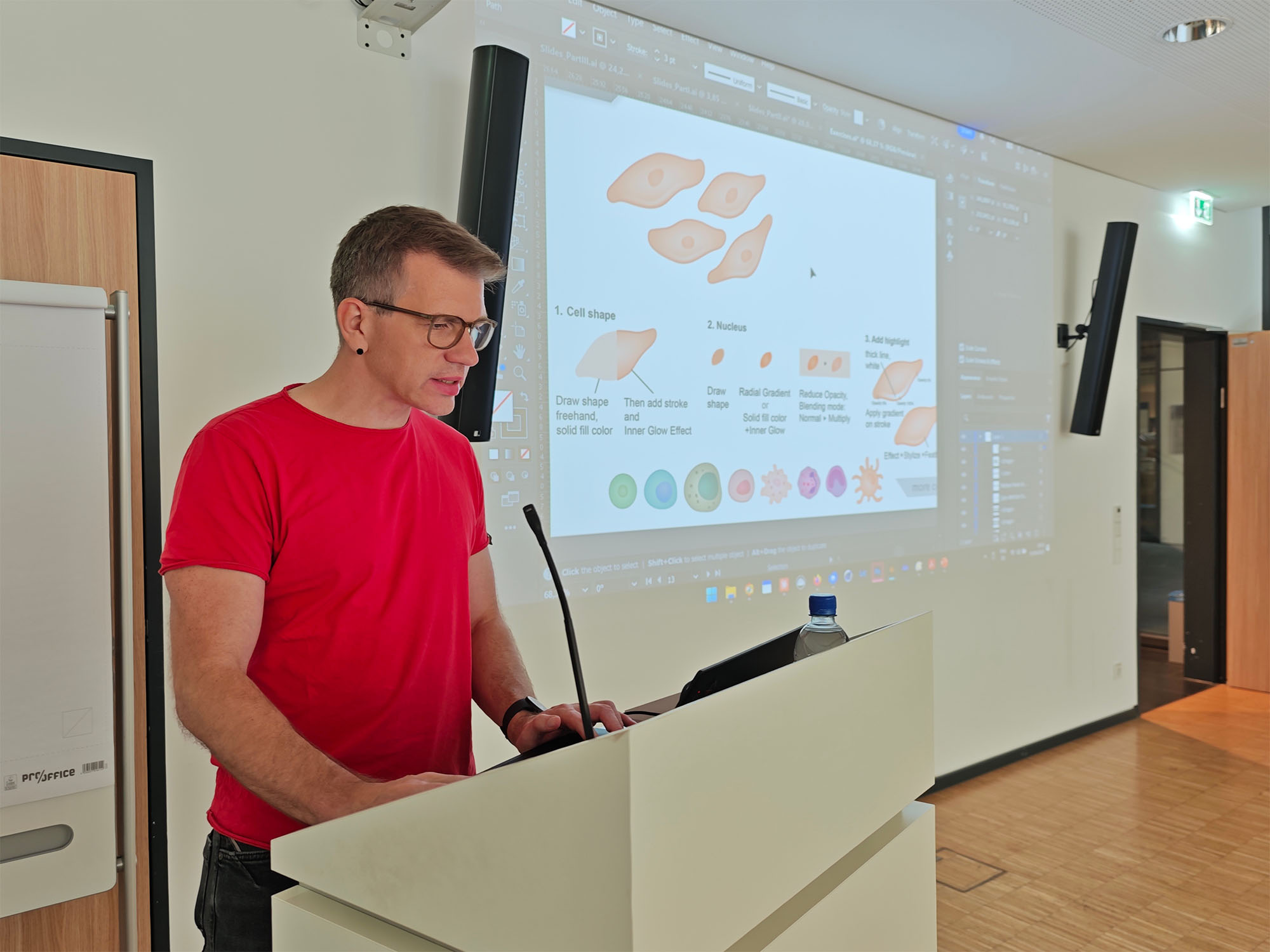
Giving a workshop at a grad school.
One expansion I wish I had done sooner is workshops. I started offering them many years into my freelance career, and they have become a genuinely valuable part of what I do, both financially and personally. Illustration work is pretty solitary by nature: most days it’s just me at the computer. Workshops are the opposite. You spend several days at a university working directly with PhD students, showing them how to think about figures and use the tools. It’s a completely different experience, and a very welcome change of pace.
Eventually, if you put in the work, you reach a point of critical mass where there’s always enough work coming in without the need of active advertising. Previous clients come back frequently, new clients find you through your website or because they saw your work somewhere. Inquiries arrive without you doing anything to generate them. That point feels amazing, when you have more requests than you can take on and you’re choosing which projects interest you rather than taking everything that comes in.
What actually makes you valuable
The obvious answer is that you can do something most scientists can’t: make their research easy to understand and visually appealing. The value here isn’t just creative talent, it’s that you understand both sides of the conversation. You’ve been through peer review. You understand why a particular figure needs to show what it shows, not just how to make it look presentable. When a client explains their research, you don’t need them to start from scratch. That saves time, reduces frustration, and produces better results. A big chunk of the work is publication figures: formatting data, creating schematics, preparing graphical abstracts. Having published papers yourself, having been through the process of preparing figures for peer-reviewed journals, knowing what editors expect, knowing how figures get used. And that’s why you don’t compete with general freelance graphic designers.
That said, you don’t need a PhD specifically, and you definitely don’t need deep expertise in every field you’ll ever illustrate. The truth is that for most projects, a solid general science background is enough. Your clients are the experts in their research. They will explain what the figure needs to show. What you need is enough scientific literacy to understand the explanation, ask the right questions, and not make obvious errors. I have a background in molecular and computational biology, and many of my illustrations reflect that. But I also regularly work with physicists, chemists and materials scientists whose fields are far from my own. The further a topic is from your background, the more you have to rely on the client to guide you, and the more time you spend getting up to speed. AI assistants are great for getting a quick surface-level understanding of an unfamiliar topic.
Being self-taught is not a weakness. I never formally studied design and nobody has ever asked me for a certificate. Clients look at your portfolio, not your CV. What matters is what you can produce.
That said, the self-taught path can create a particular kind of imposter syndrome. When you haven’t come through formal training, it can be harder to see yourself as a professional with real expertise, especially when you’re negotiating with a professor at a prestigious university. It took me longer than it should have to fully accept that fifteen years of experience and work published in high-profile journals actually constitutes expertise, regardless of how I got there.
Finally: If there’s one skill that sets you apart, it’s 3D. Most scientists cannot produce good 3D visualizations themselves. A well-rendered 3D illustration or animation immediately signals a level of professional quality that a 2D schematic cannot match, and there’s a good demand for those, particularly journal cover designs and animations, that a 2D-only illustrator cannot take on. It takes longer to learn and costs more to get into, but if you want to get a wider variety and more interesting and better-paid work, it’s worth getting into 3D.
So is it worth it?
That depends on what you’re looking for.
This job suits people who are comfortable with uncertainty. Income fluctuates, especially in the beginning. There are no colleagues, no team, no one to check in with at the end of the day. Most of the time it’s just you and your screen. If you need external structure to function well, freelancing will be a challenge (it still is for me). If you’re someone who thrives with autonomy and can tolerate the slow build of establishing something from scratch, it’s a genuinely good life.
What I didn’t expect when I started was how rewarding the work itself would feel. Not in a vague way, but specifically. Scientists spend years on research that most people will never understand or even encounter. When an illustration makes that work suddenly clear, when a figure or a cover design communicates in seconds what a paper takes pages to explain, there’s something satisfying about having been part of that. I’m aware that sounds slightly grand for what is essentially making pictures on a computer. But after fifteen years I still feel it.
I also worried early on that this work might eventually become repetitive. That hasn’t happened. Publication figures don’t sound particularly exciting from the outside, but the variety of clients, research fields, project types and formats, illustrations, animations, workshops, keeps things interesting in a way I didn’t fully anticipate. No two projects are quite the same.
There’s also the nature of the clients. Academics are, in my experience, a pleasure to work with. They care deeply about their research, they’re genuinely appreciative when you help them present it well, and the work you’re doing together actually means something to them. That’s a different experience from producing commercial content for a brand campaign. I could earn more working for pharmaceutical companies or advertising clients but I know I wouldn’t enjoy the work if it’s just about selling some product.
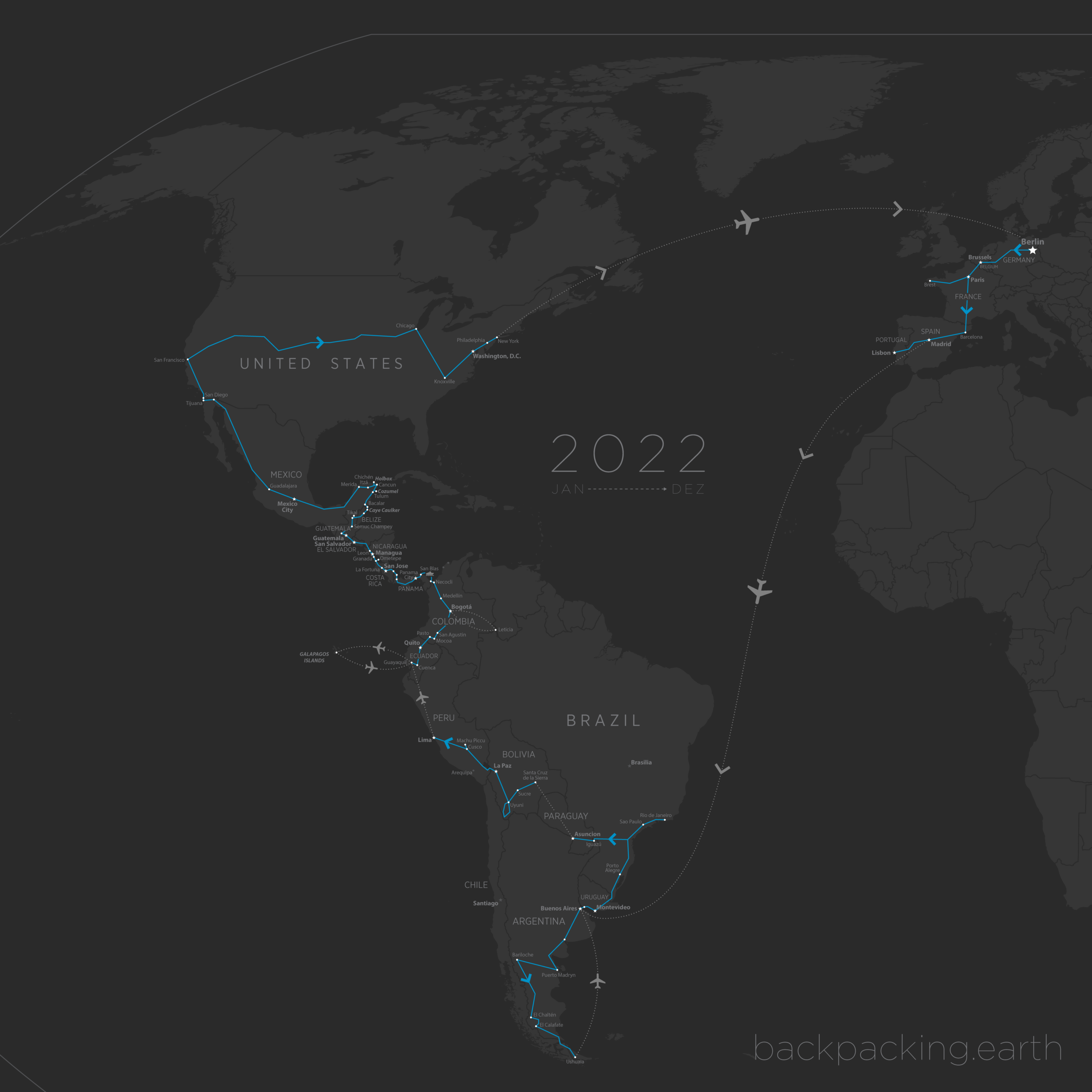
My one-year sabbatical 2022
But the freelance lifestyle also has real challenges. Working from home, probably from your bedroom when you’re starting out, makes it difficult to switch off at the end of the day. There is always unfinished work, always a looming deadline. I always valued work-life balance in theory, but in practice my stress management was poor enough that I eventually burned out properly. I simply didn’t see it coming. Looking back, it’s one of my biggest regrets from this whole career, not that I chose the wrong path, but that I didn’t listen to myself carefully enough and didn’t take my mental health seriously enough along the way. It had a real and lasting impact. In 2022 I took a year-long sabbatical and traveled through nineteen countries, which was something I really needed and loved doing. But the recovery took much longer than a year, and I’m still working through it. I mention this not to be discouraging but because I think it’s the kind of thing people rarely talk about when they describe creative freelance careers. A dedicated workspace and setting clear boundaries helps. And pay attention to how you’re actually doing, not just how productive you’re being.
Is this career for everyone who emails me asking about it? Probably not. The early years are hard, the income is uncertain, and the skills take real time to develop. But for the right person with the right passion it can be a great combination of intellectual work, creative work and genuine independence. I stumbled into it almost by accident, through a crisis I didn’t see coming and a website I happened to find at the right moment. Fifteen years later I still think it was the right call.